How Six Subscriptions Actually Handle Cancelling and Refunds
Netflix, Spotify, Adobe, YouTube Premium, NYT and Canva compared on cancelling, mid-cycle refunds and trials, from each vendor's terms. One bills you to leave.
Every subscription looks identical on the way in — a card number, a checkbox, a confirmation email. It is only on the way out that they reveal themselves as completely different animals. Some let you leave in three clicks and treat the rest of the month as yours. Others make leaving cost money. How wide is that gap? The table below answers it for six common consumer subscriptions, read straight from each vendor’s own terms and help pages rather than from a summary site, and the pattern in it is the thing worth knowing before you sign anything.
The table is the whole point of this piece. “Cancel online” versus “call us” is a design decision, and so is “no refunds” versus “here’s your money back within fourteen days.” Every cell below was read from the vendor’s cancellation page or terms of sale on the date in the verification line, and each row links to the page it came from so you can re-check it when the policy changes — and these do change.
| Service | How you cancel | Refund if you cancel mid-cycle | The catch |
|---|---|---|---|
| Netflix | Online, any time; access runs to the end of the billing period | None for partial periods — except a full refund if you cancel within 7 calendar days of a billing date and nothing was watched | No free trial, so you pay to test it |
| Spotify Premium | Online, any time | None — you keep Premium to the end of the period | Cancelling during a free trial drops you to Free immediately |
| Adobe Creative Cloud (annual, paid monthly) | Online | Full refund within 14 days; after that, an early-termination fee of 50% of the remaining contract balance | The “annual, paid monthly” plan is a contract, not a subscription |
| YouTube Premium | Online, any time; effective at the end of the billing period | None for partial or prepaid periods — except within 7 working days of ordering if you never used it | Trials are for first-time members only, one per payment method |
| New York Times (digital) | Online, phone, or chat | None — cancelling stops future charges only; access runs to the end of the period | Cancelling during a free trial ends access immediately; one trial or promo rate per person |
| Canva Pro | Online | None — fees already paid are not refunded “except where required by law” | The trial auto-converts, and billing runs on UTC, so the charge can land a day early |
Checked 2026-09-19. Prices and policies change; the links below go to the pages each row was read from.
Sources: Netflix — How to cancel, Terms of Use §3 (cancellation and refunds), free trials. Spotify — Refund policy. Adobe — Cancellation details for common Adobe plans (Adobe’s help pages refuse automated requests; the 14-day / 50% wording was confirmed from Adobe’s own page as indexed by search rather than a live fetch). YouTube — Paid Service Terms of Service, Request a refund for YouTube Premium. New York Times — Terms of Sale §2.1 (effective March 9, 2026). Canva — Terms of Use, Refunds for Canva subscriptions, Why have I been charged?.
Two kinds of subscription, one word
The first thing the table makes obvious is that there are really two kinds of subscription, and they use the same word. Netflix, Spotify, YouTube and Canva are all month-to-month at heart: you can leave any time, you keep what you paid for until the period ends, and nobody refunds the unused days. That’s not a trick, it’s just a fair rule stated plainly — you bought a month, you get a month, you stop being charged for the next one. From a budgeting angle, every one of these behaves the same way, which is why a purchase log that lists recurring charges can treat them as a single category.
Two of the “no refund” rows carry a small exception that is easy to miss and worth knowing. Netflix’s terms allow a full refund if you cancel within seven calendar days of a billing date and no content was accessed through the account in that time; YouTube’s paid-service terms allow the same within seven working days of an order you never started using. Neither is a partial refund — both are “you paid and never used it” escape hatches — but if you get billed for a plan you forgot about and have not opened it, the money is recoverable for a week.
The contract hiding inside a subscription
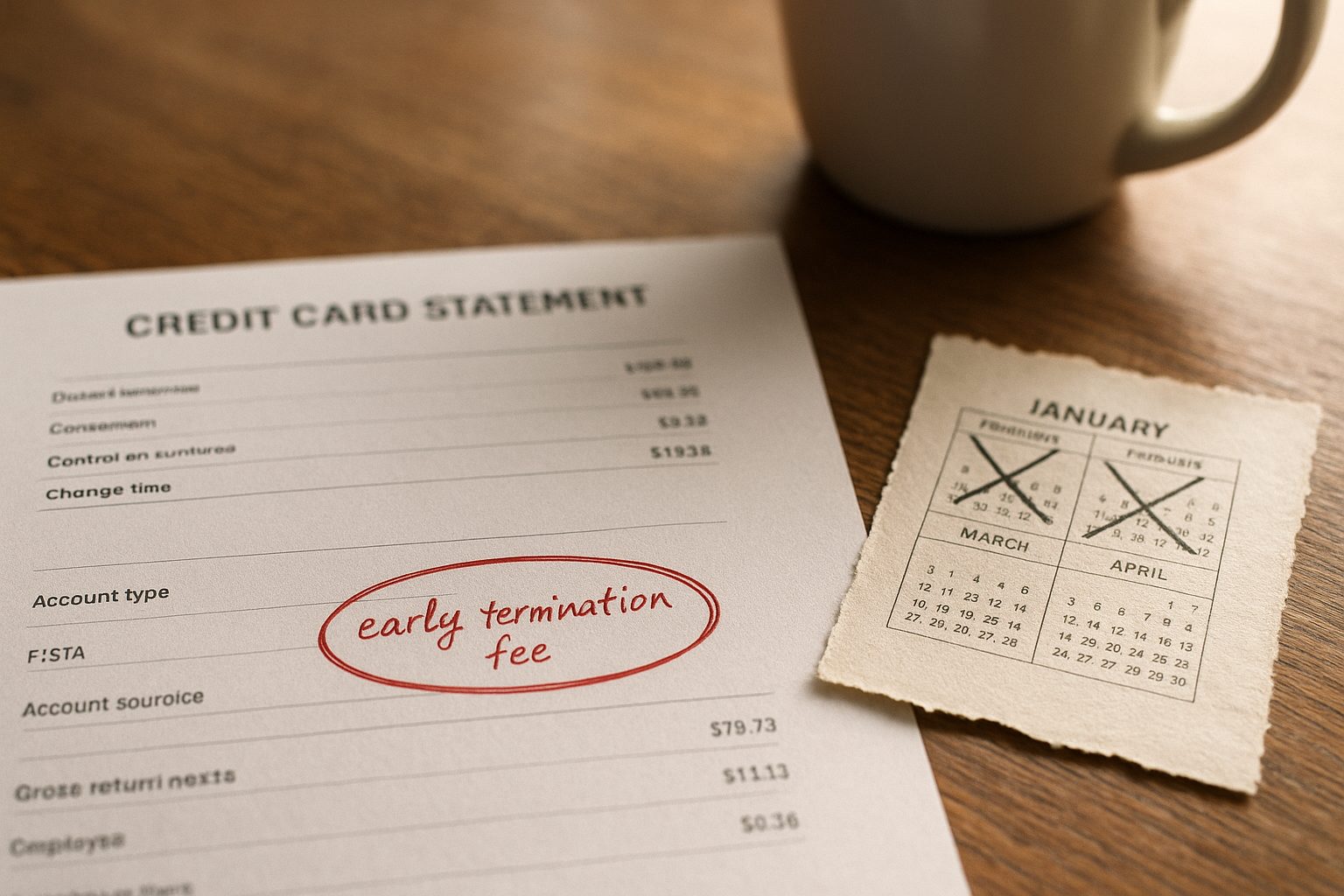
Adobe is the outlier, and it is an outlier worth pausing on because it hides a contract inside what looks like a subscription. The plan most people buy is “annual, paid monthly” — it shows up on the card as a monthly charge, which is why it feels like a month-to-month service. It is not. You signed a year, and if you leave after the first fourteen days, the exit isn’t free: Adobe’s own cancellation page states a fee of 50% of the remaining contract obligation, and gives the example that cancelling in the ninth month means paying half the fee for the three months left. Leave in month nine of twelve and you pay for a month and a half of a service you won’t be using. That’s the single most important number in the whole table, because it is the only one that turns “cancel” into an invoice.
There’s a reason Adobe structures it this way, and it’s the same reason the annual-plan discount reads like a loan: the vendor is trading you a lower monthly sticker for a commitment, and the commitment is the product. Adobe says as much on the page — the yearly subscription “comes with a significant discount,” which is why a fee applies if you cancel before the year ends. The fee isn’t buried; it’s just that “annual, paid monthly” sounds like the middle option between “monthly” and “prepaid annual” when it is actually the one with the largest exit cost.
The one that added an online exit
The New York Times is the interesting case in the other direction, because for years it was the canonical “you have to call us” service and it has since built an online cancel option for digital subscriptions billed through NYTimes.com. Its Terms of Sale now list three routes — phone, chat with a “Care Advocate,” or your account page — and it sits in the same fair category as Netflix and Spotify on the way out: cancelling “only cancels future charges,” the cancellation “will become effective at the end of your current billing period,” and you keep access until then. The wrinkle that matters: “for subscriptions that are canceled within a free trial period, your cancellation will become effective immediately.” That’s the opposite of the “keep what you paid for” rule, so if you’re mid-trial and deciding when to pull the trigger, the day you cancel is the day access stops. The same terms also say you “may only be permitted to use one free trial or promotional rate offer,” so the intro price is a once-per-person door.
Where the quiet trap lives
The free-trial column, mostly left out of the table because trial lengths shift so often, is where the quietest trap lives. Almost every one of these services auto-converts a trial into a paid plan unless you cancel first, and a few of them add their own wrinkles on top. Canva’s help centre warns that its billing system runs on UTC, so depending on your time zone the charge can appear a day earlier than you expect. YouTube’s trial is for first-time members and you can only take one per payment method. Netflix has simply stopped offering a trial at all. The through-line is that a trial is not a gift, it’s a payment method warming up — the free trial that bills you anyway is the default outcome, not the exception, for anyone who does not set a reminder.
Reading the shape, not the cell
What’s most useful about having the six side by side isn’t any single cell, it’s the shape of the whole. The month-to-month services are, almost without exception, fair on the way out — cancel online, no refund but no theft, access runs to the end of the period. The one that costs you money to leave is the one that sold you a commitment disguised as a subscription. So the rule of thumb that falls out of the table is simpler than any app: before you sign, ask whether you’re buying a month you can walk away from or a year you’ll be billed for leaving.
The counterpoint that keeps this honest is that the “fair” month-to-month services are only fair because you pay for that fairness in a higher effective price. A monthly plan with no commitment is the vendor’s full sticker every single month; Adobe’s early-termination fee is the price of its lower monthly sticker. There is no service in this table that is generous on both sides, and expecting one is how you get surprised. The fee and the refund policy and the trial are all the same thing wearing different costumes: the price of the exit.
There’s a second trap in the table that is easy to miss because it isn’t about leaving at all, it’s about the gap between “cancel” and “stop paying.” Every service here keeps your access running to the end of the current billing period, which is fair — but it means cancelling today does not stop today’s obligation, and if you cancel the day after a renewal you’ve already bought another full period. The timing of when you cancel relative to your renewal date matters more than which button you click. Pause and cancellation differ: a pause can skip a payment while scheduling an automatic restart, so check both the effective date and the next charge. And note that the table only covers subscriptions bought directly from the vendor — if you subscribed through an app store, the same subscription is a different cancellation, governed by Apple’s or Google’s refund rules rather than the ones above.
Three questions, in a fixed order
The practical method that falls out of this is three questions, asked in a fixed order before giving anyone a card. One: if I cancel next month, do I keep the rest of what I paid for, or is there a fee? Two: does the trial auto-convert, and on whose calendar? Three: can I cancel online, or is leaving a phone call? None of these questions takes more than a minute to answer from the vendor’s terms page, and together they catch every surprise in the table above — including the small one, since small subscriptions are the hardest to cancel precisely because nobody asks these questions about a $5 charge.
There’s nothing mysterious about cancellation policies once you read them side by side, but almost nobody reads them side by side — they read them one at a time, under the influence of a discount, on the day they’re signing up, which is the worst possible moment to think clearly about leaving. The table is the antidote. Most subscriptions will let you go quietly and keep what you paid for; one here will bill you for the exit; and the difference between the two is printed in plain text on a terms page you never open until it’s too late. Reading it first is the cheapest insurance against a recurring charge there is.
Related reading
Which Gift Cards Actually Stop a Subscription From Auto-Renewing
Compare gift-card renewal rules for seven services, including saved-card billing, prepaid-plan exceptions, and what to check before redeeming credit.

Cost Per Use: The Subscription Math That Changes Decisions
Divide a subscription's monthly price by how often you use it. Flat-rate bias research, where Netflix, Spotify and YouTube keep usage logs, and a worksheet.

Pause or Cancel a Subscription? Netflix and YouTube TV Rules Compared
Compare Netflix and YouTube TV pause limits, automatic restart billing, and access rules, then use a checklist to decide whether to pause or cancel your plan.
Streaming Prices: Compare Ads, 4K and the Plan You Need
Compare US streaming prices, ad-free upgrades, 4K and screen limits with official sources, verification gaps, and a worksheet for your annual viewing budget.