Streaming Prices: Compare Ads, 4K and the Plan You Need
Compare US streaming prices, ad-free upgrades, 4K and screen limits with official sources, verification gaps, and a worksheet for your annual viewing budget.
Streaming costs depend on the shows you want, how many people watch at once, and whether you value removing ads. An entry plan can be the right plan. Paying more is useful only when the extra features solve a need you actually have.
Correction, September 27, 2026: The earlier table confused a Disney+/Hulu bundle offer with Disney+ standalone pricing. It also presented mixed press and vendor sources as entirely verified pricing-page research, and made unsupported claims about subscriber behavior and company motives. This revision separates confirmed figures from verification gaps and replaces those claims with a comparison method. It is a documentation review, not a hands-on streaming test.
Illustration only. The pictured bill is not evidence of a typical customer’s spending.
US price comparison and its limits
Checked September 27, 2026, except Amazon, rechecked October 25, 2026, and the Disney bundle section, rechecked October 26, 2026. Netflix features and the $8.99 ad-plan price were rechecked October 26; its Standard and Premium US prices below retain the September 27 check because the help page returned Japanese pricing during this review. HBO Max and Peacock prices and plan limits were rechecked October 27, 2026. Dollar amounts are US dollars before applicable taxes. Direct subscriptions, bundles, account offers and third-party billing can differ. “Unconfirmed” means the opened primary page did not establish that field during this check; it does not mean the plan or feature is unavailable. Search snippets were not treated as a substitute for readable plan details.
| Service or offer | Confirmed monthly price | Higher tier or add-on | Limits and verification gaps | Primary source |
|---|---|---|---|---|
| Netflix | Standard with ads $8.99; Standard $19.99 | Premium $26.99 | First two: 2 streams, 1080p; Premium: 4 streams, 4K/HDR. Ad tier excludes some titles and older devices. No annual plan. Standard/Premium US prices not reverified October 26. | Netflix plans, ad-plan details |
| Apple TV | $14.99 after trial | No separate upgrade established here | Apple Originals commercial-free; annual price and simultaneous-stream count unconfirmed. Family-sharing membership is not a stream-count specification. | Apple TV |
| Disney+ standalone | Unconfirmed | Unconfirmed | The readable page supplied bundle prices, not a verified standalone comparison. | Disney+ plans |
| Hulu standalone | Unconfirmed | Unconfirmed | Public help/plan pages did not expose a usable current price table in this check. Confirm at checkout. | Hulu plans |
| HBO Max | Basic with Ads $10.99; Standard $18.49 | Premium $22.99 | First two: 2 streams, 1080p; Premium: 4 streams, but only 2 for sports; 4K where available. Included live sports requires Standard or Premium. Annual: $109.99 / $184.99 / $229.99. | HBO Max US plans |
| Paramount+ | Unconfirmed | Unconfirmed | Opened homepage did not expose plan prices; previous press-based figures are not certified by this audit. | Paramount+ |
| Peacock | Select $8.99; Premium $12.99 | Premium Plus $19.99 | Select excludes movies, sports, live programming and Peacock Originals. Plus retains ads in channels, live sports/events and some shows/movies. Annual: $89.99 / $129.99 / $199.99. Stream count and 4K not established by this page. | Peacock plan comparison |
| Prime Video through Prime membership | Prime $14.99/month or $139/year | Ultra adds $4.99/month | Base: 4 streams; Ultra: 5, 4K and Dolby Atmos, subject to content/device limits. Ultra annual $45.99 requires annual Prime. Live events and some other content retain ads even with Ultra. Standalone base price unconfirmed here. | Amazon Ultra details |
These rows are not a ranking of interchangeable catalogs. Peacock Select and Premium differ in available content, while Prime includes benefits outside video. A household already keeping Prime for other reasons faces a different incremental decision from someone buying it solely to watch television. Put the full membership cost in the latter comparison; do not describe an add-on price as the complete subscription.
The table also separates missing evidence from a negative finding. An absent annual price does not establish monthly-only billing. An unspecified resolution does not establish HD-only streaming. Before relying on either feature, confirm the exact plan in your account and retain the terms alongside the price.
Calculate the upgrade you actually want
Using the Netflix prices recorded in the table, moving from the ad tier to Standard adds $11 a month, or $132 over twelve unchanged-price months. Premium adds another $7 monthly, or $84 yearly. Those are different decisions: removing commercials does not itself increase that service’s simultaneous-stream limit.
For HBO Max, the monthly difference between Basic and Standard is $7.50; Standard to Premium adds $4.50. For Peacock, compare Premium to Premium Plus when evaluating ad removal across its broader catalog: the difference is $7 monthly. Comparing Select to Plus also changes the catalog, so it cannot isolate the price of removing ads.
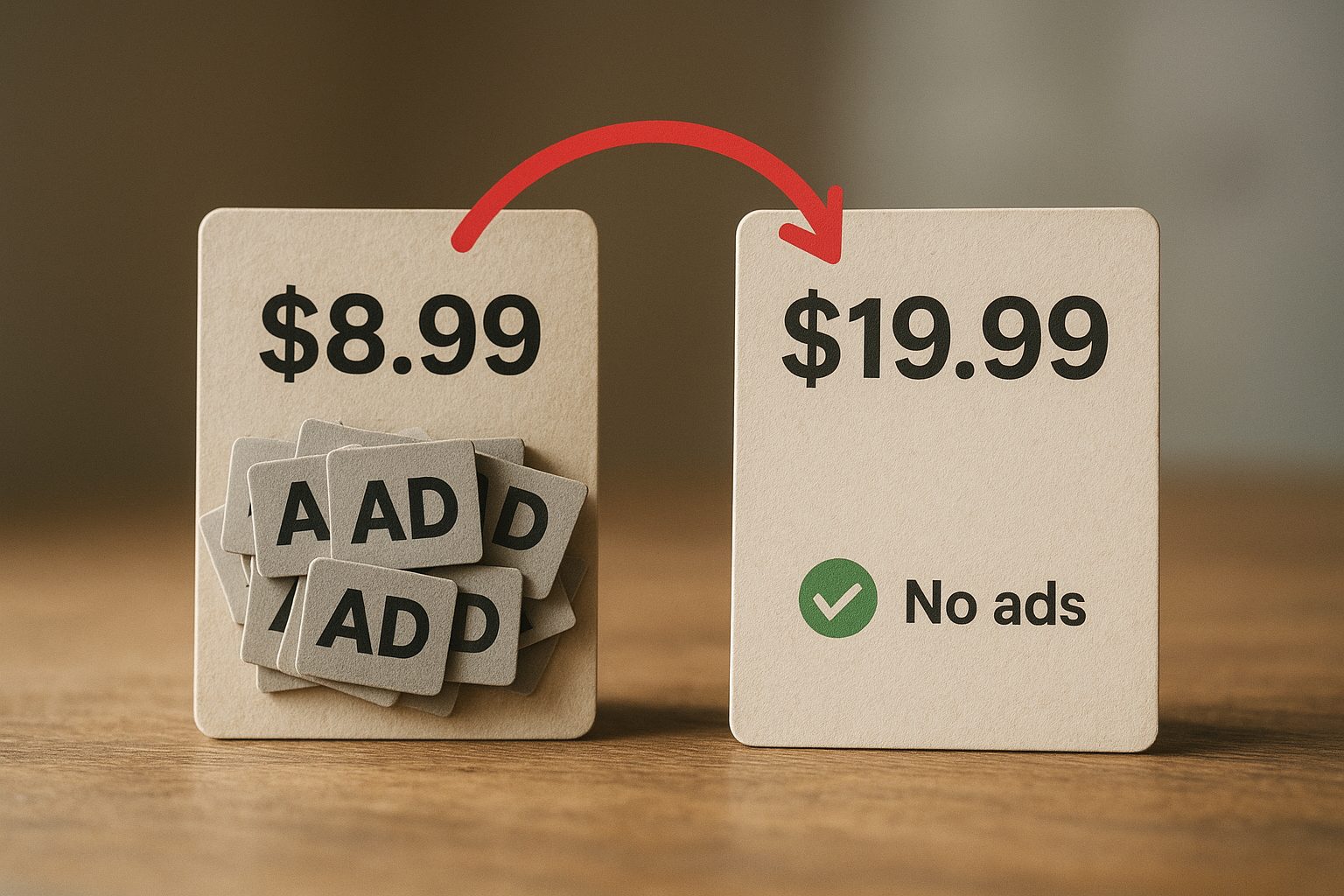
Illustration only. Plan differences do not measure advertising revenue or customer upgrade rates.
These differences describe listed charges, not the providers’ margins or the amount advertisers contribute. Nor do they show that most customers upgrade. Someone content with an ad-supported plan should budget that plan rather than a hypothetical future upgrade. The relevant comparison is the cheapest eligible plan meeting your requirements.
For your own comparison, write down the feature that triggers each added cost. If the reason is merely “this looks like the normal plan,” pause and specify the missing benefit. If it is “three people need different shows at the same time,” check concurrency. If it is “this particular film in 4K,” check the title and playback setup as well as the tier.
Netflix: check the title and device before the upgrade
Netflix’s ad-plan details, checked October 26, 2026, list $8.99 monthly and explain two limits beyond commercial breaks: some titles are unavailable because of licensing, and some older TVs or devices cannot use this plan. Unavailable titles show a lock icon. Before subscribing for one series, check its availability on the intended plan and the compatibility of your playback device.
If both checks pass and two simultaneous streams are enough, the ad tier may meet your needs. If the title is locked, compare Standard before paying for Premium: Standard still offers two streams at 1080p. Premium’s four streams and 4K address separate requirements. Downloads are already included on the ad tier, so offline viewing alone is not a reason to upgrade.
The $132 annual upgrade difference above assumes twelve months at the recorded prices. For a three-month viewing season, the same $11 monthly difference is $33. Confirm the current Standard price first; these are calculated spending differences, not a measured value of avoiding commercials.
HBO Max: price the sports requirement and viewing season
The US plan comparison, checked October 27, 2026, includes live sports with Standard and Premium. Basic therefore is not the comparison baseline for someone subscribing for those events. Premium still limits sports to two simultaneous streams; its four-stream headline does not buy four concurrent sports streams.
Using the listed prices, these are calculated spending totals before tax, assuming no price changes or promotions:
| Plan | Three monthly payments | Ten monthly payments | Eleven monthly payments | Annual payment |
|---|---|---|---|---|
| Basic with Ads | $32.97 | $109.90 | $120.89 | $109.99 |
| Standard | $55.47 | $184.90 | $203.39 | $184.99 |
| Premium | $68.97 | $229.90 | $252.89 | $229.99 |
For each tier, ten monthly payments cost nine cents less than annual billing; annual becomes cheaper at eleven months. A three-month Standard viewing season costs $55.47, compared with $184.99 prepaid for a year. Match the billing period to intended use before treating the advertised annual saving as money saved. Confirm that your billing provider offers the chosen plan and interval.
Peacock: check what the upgrade removes
Peacock’s plan comparison and FAQ, checked October 27, 2026, distinguish catalog access from ad removal. Select excludes live programming as well as movies, sports and Originals. Premium includes the broader catalog; Premium Plus adds eligible downloads and live local NBC access, but channels, live sports/events and some shows and movies still carry ads. Sponsored features also remain. Buying Plus for a game therefore does not guarantee an uninterrupted broadcast.
Using the table’s verified prices, a three-month Premium subscription totals $38.97; Plus totals $59.97. The calculated $21 upgrade buys the additional features for that period, not a promise that every program is commercial-free. Check whether your intended downloads are eligible before paying for that benefit.
For annual billing, Premium costs $129.99 versus $155.88 for twelve monthly payments; Plus costs $199.99 versus $239.88. Those calculated savings assume a full year of use and unchanged prices, before tax. For three months, prepaying Premium instead adds $91.02 to the intended spend. Decide on the viewing period before using an annual discount to justify the purchase.
Prime Video: add the membership before comparing Ultra
Amazon’s Ultra comparison, checked October 25, 2026, confirms that Ultra requires a Prime or Prime Video subscription. “Ad-free” has exceptions: live television, events such as sports, and some ad-supported content or subscriptions can still show ads. Upgrading for a live game therefore does not promise a commercial-free broadcast.
Using the table’s prices, these are calculated totals before tax, assuming unchanged prices and no promotions:
| Billing choice | Calculation | Total |
|---|---|---|
| Monthly Prime plus monthly Ultra | $14.99 + $4.99 | $19.98/month; $239.76 for twelve payments |
| Annual Prime plus annual Ultra | $139 + $45.99 | $184.99/year |
| Annual Prime plus three months of Ultra | $139 + (3 × $4.99) | $153.97 for that year |
The annual Ultra option requires annual Prime. If you already plan to keep annual Prime, nine monthly Ultra payments cost $44.91; ten cost $49.90. Its $45.99 annual option becomes cheaper at ten months of use. This is a billing comparison, not a recommendation to buy a year for a short viewing season. These totals cover the Prime-membership route; they do not establish the price of standalone Prime Video.
Keep resolution, streams and households separate
A plan can advertise 4K without every title supporting it. The television, playback device and connection also matter. Use the equipment you already watch on to decide whether a resolution upgrade is worth paying for; a badge alone cannot establish a visible improvement in your room.
Illustration only. This is not a measured picture-quality comparison.
Count simultaneous viewing sessions, not profiles or registered devices. Four family members who watch together need one stream at that moment. Two people independently watching while a third uses another device need three. Check special content restrictions too: the HBO Max sports exception in the table is material to a household buying Premium for concurrent games.
An outside-household member is a separate question from another screen in the same home. Do not assume that purchasing more streams authorizes sharing in another residence. Check the service’s household rules, add-on eligibility and billing provider before treating a shared plan as an option.

Illustration only. Extra-member charges and simultaneous-stream limits are different conditions.
Distinguish a bundle from a standalone plan
Disney’s plans and offer terms, checked October 26, 2026, list Disney+/Hulu at $12.99 monthly or $71.94 for an initial six-month term, then $12.99 monthly. Premium is $21.99 monthly or $119.94 for the initial six months, then $21.99 monthly. These are bundles, not standalone Disney+ prices. The same page lists Disney+/Hulu/HBO Max at $21.99 with ads or $34.99 without ads; select live and linear content retains ads.
For the six-month offer, an initial-term cancellation takes effect at that term’s end; after renewal, cancellation takes effect at the end of the monthly billing period. Check your eligibility and billing route at checkout. This review did not test cancellation or establish refund exceptions.
Disney bundle: compare the commitment with your viewing season
The following totals are calculated from those listed rates, before tax, with no later price change or extra promotion. The six-month route includes its full initial obligation even if you intend to watch for only three months.
| Intended viewing period | Regular bundle, monthly route | Regular bundle, six-month route | Premium, monthly route | Premium, six-month route |
|---|---|---|---|---|
| 3 months | $38.97 | $71.94 | $65.97 | $119.94 |
| 6 months | $77.94 | $71.94 | $131.94 | $119.94 |
| 12 months | $155.88 | $149.88 | $263.88 | $251.88 |
For example, the regular bundle’s first-year offer total is $71.94 + (6 × $12.99) = $149.88. Multiplying the advertised $11.99 equivalent by twelve would understate that year by $6 because the introductory rate ends after six months. Premium’s corresponding calculation is $119.94 + (6 × $21.99) = $251.88.
At these rates, both six-month offers become cheaper than monthly billing only when you need all six months: five regular payments total $64.95 and five Premium payments total $109.95, each below its initial-term price. For a three-month season, monthly billing avoids $32.97 or $53.97 respectively, provided you cancel before the next renewal. Set a reminder for the term ending in your account, rather than interpreting the monthly equivalent as permission to stop paying after one month.
A bundle comparison should include only services you would otherwise buy. Saving against three standalone subscriptions has little meaning if you need just one. The bundle-use comparison helps separate included content from content you intend to watch.
A worksheet for a realistic viewing budget
Use the same time horizon for every option. Twelve months makes upgrades easy to compare, but a three-month viewing plan should remain three months in the calculation. Do not silently assume year-round use to make annual billing look attractive.
| Field | What to record before paying |
|---|---|
| Viewing need | Named shows or events, and the months you expect to watch |
| Exact product | Standalone service, bundle, or add-on; include the base membership |
| Required features | Ads preference, simultaneous sessions, resolution and downloads |
| Initial obligation | Amount charged now and the period it purchases |
| Renewal | Date, next price and billing interval |
| Exceptions | Ads on live content, unavailable titles, sports or device restrictions |
| Existing overlap | Services already paid through another membership or provider |
| Evidence | Checkout price, plan terms and date saved |
| Exit action | Where to cancel and when cancellation becomes effective |
For an explicitly hypothetical plan costing $15 monthly or $150 annually, the annual option equals ten monthly payments. Six months of use costs $90 on monthly billing, so prepaying the year costs $60 more for that intended use. Twelve monthly payments cost $180, so annual billing saves $30 only under the full-year comparison. This is why annual versus monthly needs an expected-use period as well as a discount percentage.
For an introductory offer, add each period separately: initial charge plus later recurring charges plus necessary add-ons and taxes. Keep the renewal amount visible even if the first payment is smaller. Record the biller too; a subscription sold through an app store or another provider may require a different cancellation route.
Finally, compare the resulting schedule against your renewal calendar. A good choice meets a specific viewing need at a price you accept. Neither the lowest advertised figure nor the highest tier answers that question without the plan’s limits and your intended months of use.
Related reading
Which Gift Cards Actually Stop a Subscription From Auto-Renewing
Compare gift-card renewal rules for seven services, including saved-card billing, prepaid-plan exceptions, and what to check before redeeming credit.
Which Subscriptions Let You Quit Online — and Which Still Make You Call
Gyms and cable still force a phone call, a letter, or an in-person visit to cancel; Audible and Amazon take two clicks. Eight subscriptions compared on leaving.
What Actually Happens to Your Data When You Cancel a Subscription
What seven subscriptions keep after you stop paying, from their own help pages. Netflix holds history 10 months; Adobe and Dropbox start a 30-day clock.
The Discount They Offer When You Cancel: What It Means
Retention offers explained: why firms discount only when you try to leave, what the Amazon, SiriusXM and Adobe cases showed, and a rule for deciding.