The Discount They Offer When You Cancel: What It Means
Retention offers explained: why firms discount only when you try to leave, what the Amazon, SiriusXM and Adobe cases showed, and a rule for deciding.
Most cancellation flows have a screen that appears only after you click “cancel”: a lower price, a free month, a pause, a cheaper plan. The industry calls it a retention offer or a save offer. It is the one price the company was not planning to show you, and it is worth understanding before you decide whether to take it.
This guide does three things. It summarises what economists say a retention offer is for, and why a company that can afford the discount does not simply charge less to everyone. It sets out what three public enforcement records show about how these screens are built. And it gives a short procedure for deciding, with the arithmetic labelled so you can substitute your own numbers.
Correction, September 27, 2026: an earlier version of this article was written as a personal account of reading these offers and changing how the author cancelled. That account was not drawn from any record and has been removed. Everything below rests on published research, court and agency documents, and clearly labelled hypothetical figures.
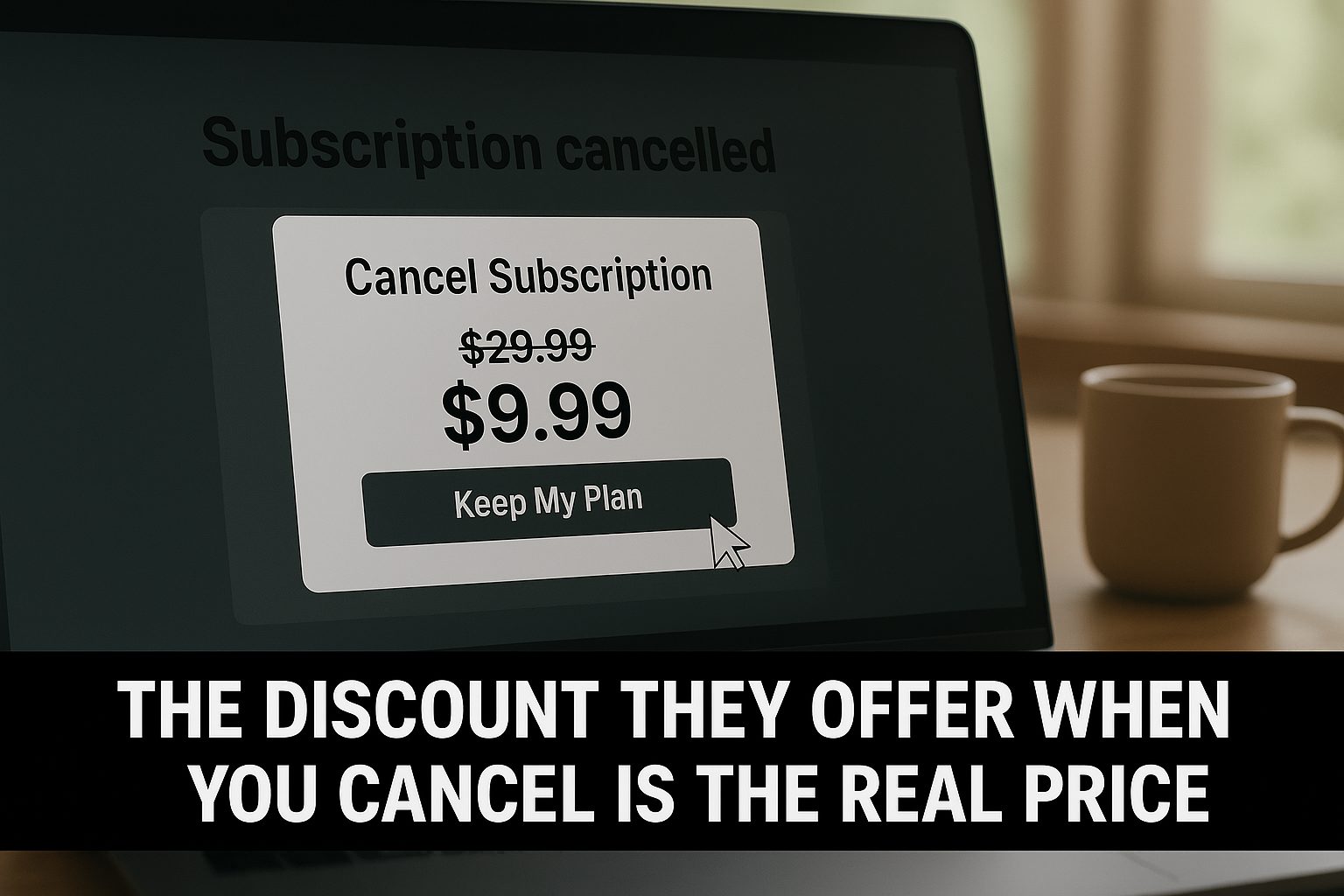 Illustration only; not a screenshot of any real service.
What a retention offer is for
The obvious reading is that the company is trying to keep you. That is true, but it does not explain the puzzle: if a lower price keeps customers, why not offer it up front? Two theoretical papers answer that question in different ways. Sources opened September 27, 2026.
| Source | Model | What it concludes about retention offers | Limits |
|---|---|---|---|
| Haan & Siekman, “Behavior-based Price Discrimination and the Use of Retention Offers” (working paper, University of Groningen, January 2, 2026) | Two firms, two periods; customers differ in how costly they find switching, and starting a cancellation is itself costly | Retention offers work as a screening device. Only customers who find switching cheap bother to start the cancellation, so the firm can charge them less without lowering the price for everyone else. The paper finds retention offers “increase profits but reduce consumer surplus and total welfare”; customers who would never have left end up paying more, and even those who get the offer may lose once higher first-period prices are counted. | Theory, not measurement. Working paper, not yet peer-reviewed at the checked date. |
| Esteves, “Behavior-based price discrimination with retention offers” (Information Economics and Policy 27, 2014, pp. 39–51) | Two firms that try to poach each other’s customers and can answer a poaching offer with a retention offer | Retention offers raise the price paid by loyal customers and lower it for those who receive an offer. In this model the combination of poaching and retention lowers industry profit and raises consumer welfare overall. | Theory; different assumptions from Haan & Siekman, and the opposite welfare result. |
The two papers disagree about whether the practice is good or bad for consumers as a group. They agree on the mechanism, which is the useful part for an individual reader: the company is not guessing what the service is worth to you. It is sorting customers by how willing they are to leave, and charging the ones who stay put more. Reaching the cancel screen moves you from one group to the other. That is why the offer appears there and nowhere else.
It also answers the “why not just charge less” question. Lowering the list price would give the discount to every customer, including the majority who would have paid full price without complaint. Giving it only to people who start a cancellation keeps the list price intact for everyone else. Haan and Siekman note that some customers actively seek these offers out, trading strategies on forums, while many others “appear largely unaware of such offers, or unwilling to exploit them.” The price you pay depends on which of those two people you are.
 Illustration only.
What the enforcement record shows
Theory says why the screen exists. Three public cases show what companies actually built. None of these is about a retention offer being illegal in itself; offering a discount to a departing customer is lawful. The cases are about what happens when the offer becomes an obstacle. Sources opened September 27, 2026.
| Case | What the cancellation flow did, per the record | Outcome | Source |
|---|---|---|---|
| FTC v. Amazon (Prime) | The FTC’s June 21, 2023 complaint described a flow Amazon named “Iliad”: consumers who found the cancellation page “were redirected to multiple pages that presented several offers to continue the subscription at a discounted price, to simply turn off the auto-renew feature, or to decide not to cancel. Only after clicking through these pages could consumers finally cancel.” | Settled September 25, 2025: a $1 billion civil penalty and $1.5 billion in consumer refunds, which the FTC says covers “the estimated 35 million consumers impacted by unwanted Prime enrollment or deferred cancellation.” The order requires “an easy way for consumers to cancel Prime, using the same method that consumers used to sign up.” | FTC complaint announcement, June 21, 2023; FTC settlement announcement, September 25, 2025 |
| New York v. SiriusXM | The Attorney General’s December 20, 2023 filing said agents were trained to hold departing customers in “a lengthy six-part conversation” and to pitch “as many as five retention offers,” and that by SiriusXM’s own data cancelling took an average of 11.5 minutes by phone and 30 minutes online. | A New York court ruled in November 2024 that the process violated the federal Restore Online Shoppers’ Confidence Act because it was “significantly more complicated than the process consumers use to sign up.” SiriusXM must give New York customers a simple way to cancel without speaking to an agent. | NY AG lawsuit announcement, December 20, 2023; NY AG ruling announcement, November 22, 2024 |
| FTC / DOJ v. Adobe | The June 17, 2024 complaint said Adobe’s default “annual, paid monthly” plan carried an early termination fee of “50 percent of the remaining monthly payments when a consumer cancels in their first year,” disclosed in small print at sign-up and made clear only at cancellation. This is the retention screen in reverse: instead of a discount to stay, a charge to leave. | Settled March 13, 2026: $75 million in civil penalties and $75 million in free services to customers. Adobe must “clearly disclose any Early Termination Fee and how the fee is calculated before enrolling customers” and provide “easy ways to cancel.” | FTC complaint announcement, June 17, 2024; DOJ settlement announcement, March 13, 2026 |
Two details from that table matter for a reader standing at a cancel screen. First, the Amazon record confirms that the offers were designed as pages to click through, not as a single choice. A flow with a discount, then a pause option, then a “keep my benefits” button is not unusual; it was the design of the largest subscription service in the country. Second, the SiriusXM figures show the cost of the screen is partly time. Half an hour is a real price, and the company’s own data put that number on it. A separate article covers which services let you quit online and which still route you to an agent.
What the offers usually are
There is no neutral public dataset on retention offers. The closest thing is vendor data from companies that sell cancellation-flow software, which has an obvious interest and should be read with that in mind.
| Source | Sample | What it reports | Limits |
|---|---|---|---|
| Churnkey, State of Retention 2025 | Over 1,000 subscription businesses using the vendor’s tools, about 3 million cancellation sessions in 2024 | Among offers that were accepted, discounts made up about 53%, pauses 19% and plan changes 7%. The most common reasons customers gave for cancelling were budget (33%) and infrequent use (31%). | Vendor report; customer base self-selected toward businesses that run save offers; the report does not state an overall save rate or how long saved customers stayed. |
The reason breakdown is the useful number. Roughly a third of people cancelling say they do not use the service enough. For them a discount does not fix the problem; it makes the unused thing cheaper. That is the case the next section is built around.
Three rules for reading the screen
1. Decide the number before you click cancel. The offer is an anchor, and it arrives at the moment you have the least time to think. Write down, before you start, the monthly price at which you would genuinely keep the service. Then compare the offer to that number rather than to the list price you were paying. The list price is not the relevant comparison; it is the price the company charges people who never reach this screen. There is more on why the first number you see tends to set the decision.
2. Price the year, not the offer. Most save discounts are temporary. The price that matters is the one that resumes when the offer ends, because that is the price you will be paying on the day you have forgotten about this screen. The table below uses hypothetical figures: a $15.99 list price and two offers of the kind that commonly appear. Substitute the real prices from your own flow.
| Option (hypothetical) | Months 1–3 | Months 4–12 | 12-month total | Effective monthly |
|---|---|---|---|---|
| Keep paying list price, $15.99 | $47.97 | $143.91 | $191.88 | $15.99 |
| Offer A: $7.99 for 3 months, then $15.99 | $23.97 | $143.91 | $167.88 | $13.99 |
| Offer B: $9.99 for 12 months | $29.97 | $89.91 | $119.88 | $9.99 |
| Cancel now, re-subscribe at list for 3 months when needed | $0 | $47.97 | $47.97 | $4.00 |
| Cancel | $0 | $0 | $0 | $0 |
Offer A saves $24.00 across the year, all of it in the first quarter, and then returns you to the price you were leaving. If your written-down number was $8, Offer A meets it for three months and then fails it for nine. Offer B meets it for the whole year. The offers look similar on the screen; over twelve months one is a real re-pricing and the other is a delay. If you accept a short offer, put the end date in your calendar the same day. The same snap-back mechanics apply to the discount inside a renewal email, which is the same screen aimed at a different moment.
3. A discount on something you do not use is not a discount. If the reason you reached the cancel screen was that the service sat idle, the offer changes the price of idleness and nothing else. The cost-per-use arithmetic is the check: divide the offer price by the number of times you actually opened the thing last month. The same applies to a just-in-case subscription kept for a need that has not arrived; the fourth row of the table, cancelling and coming back at list price only when needed, is usually cheaper than any offer.
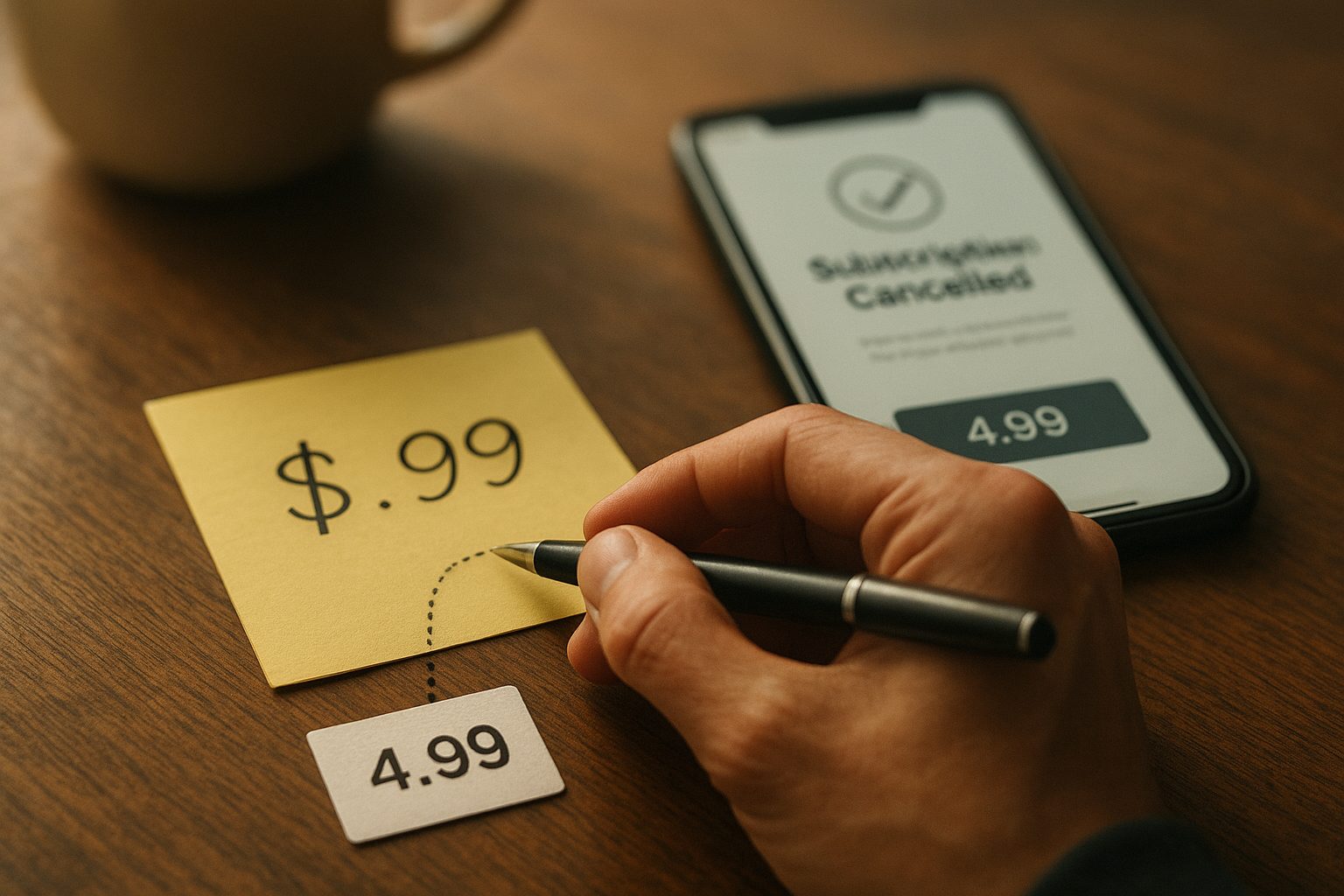 Illustration only; the figures in the image are not from any real offer.
A record to keep
The offer is information about the company even if you decline it. Keep one line per cancellation so the next renewal decision starts from what the company actually offered rather than from the list price.
| Field | What to write |
|---|---|
| Service and plan | As shown on the billing page |
| List price you were paying | Monthly equivalent |
| Your number, written before clicking | The monthly price at which you would keep it |
| Offer shown | Price, and whether it was a discount, pause, or plan change |
| Offer term | How many months, and the price after it ends |
| Time spent | Minutes from “cancel” to confirmation, and whether an agent was required |
| Decision | Accepted, declined, or paused |
| Re-check date | The day the offer ends, if accepted |
The “time spent” field is there because the SiriusXM record shows it can be the largest hidden cost of the screen, and because a service that takes half an hour to leave is one to think twice about re-joining.
 Illustration only.
Where the rules stand
In the United States there is currently no federal rule that limits how many offers a cancellation flow may show. The FTC’s 2024 “click-to-cancel” amendments to its Negative Option Rule, which would have required cancellation to be as easy as sign-up, were vacated by the Eighth Circuit on July 8, 2025 on procedural grounds and never took effect (Crowell & Moring summary). On March 11, 2026 the FTC opened a new rulemaking with an advance notice asking for evidence on practices that “deter consumers from canceling their enrollments,” with comments due April 13, 2026 (FTC announcement). Until that produces a rule, the practical protections are the case-by-case ones in the table above, plus state law such as New York’s. A related article covers who gives you an off switch for auto-renewal, which is the other half of the same problem.
None of this is an argument that every subscription should be cancelled on principle, or that accepting a retention offer is a mistake. Offer B in the table is a genuine re-pricing, and a customer who takes it and uses the service has done well. The argument is narrower: the price on the pricing page is the price for people who do not look, and the screen that appears when you try to leave is the company telling you what it will accept from people who do. Decide your number before you see theirs.
Sources
All opened September 27, 2026 (KST).
- Haan, M. A. and Siekman, W. H., “Behavior-based Price Discrimination and the Use of Retention Offers”, working paper dated January 2, 2026.
- Esteves, R.-B., “Behavior-based price discrimination with retention offers”, Information Economics and Policy 27 (2014), pp. 39–51; working-paper listing.
- FTC, “FTC Takes Action Against Amazon for Enrolling Consumers in Amazon Prime Without Consent and Sabotaging Their Attempts to Cancel”, June 21, 2023.
- FTC, “FTC Secures Historic $2.5 Billion Settlement Against Amazon”, September 25, 2025.
- New York Attorney General, “Attorney General James Sues SiriusXM Radio for Trapping Consumers in Unwanted Subscriptions”, December 20, 2023.
- New York Attorney General, “Attorney General James Stops SiriusXM from Trapping New York Customers in Unwanted Subscriptions”, November 22, 2024.
- FTC, “FTC Takes Action Against Adobe and Executives for Hiding Fees, Preventing Consumers from Easily Cancelling Software Subscriptions”, June 17, 2024.
- US Department of Justice, “Adobe Agrees to $150 Million Settlement and Injunction to Resolve Alleged Violations of the Restore Online Shoppers’ Confidence Act”, March 13, 2026.
- Churnkey, State of Retention 2025. Vendor report.
- FTC, “FTC Seeks Public Comment in Response to Advance Notice of Proposed Rulemaking Regarding Negative Option Marketing Practices”, March 11, 2026.
- Crowell & Moring, “Clicking All the Right Boxes: FTC Moves to Revive ‘Click-to-Cancel’ Rule Following Eighth Circuit Vacatur”, 2026. Secondary source for the July 8, 2025 vacatur date.
Prices in the arithmetic table are hypothetical. Case descriptions are taken from the agencies’ own announcements, not from the underlying court filings, and describe allegations and settlement terms rather than adjudicated findings except where a court ruling is stated.
Related reading
Most Subscriptions Have No Turn Off Auto-Renew Button
How to turn off auto-renew on nine subscriptions: most make you cancel, Microsoft has a real off switch, and Adobe charges 50% to leave.
Streaming Prices: Compare Ads, 4K and the Plan You Need
Compare US streaming prices, ad-free upgrades, 4K and screen limits with official sources, verification gaps, and a worksheet for your annual viewing budget.
Which Subscriptions Let You Quit Online — and Which Still Make You Call
Gyms and cable still force a phone call, a letter, or an in-person visit to cancel; Audible and Amazon take two clicks. Eight subscriptions compared on leaving.

Where Your Subscriptions Are Hiding, and the Tools That Find Them
Subscriptions hide in five places and no single app lists them all. Here's what bank-linked detectors, manual trackers and free lists each find.