Why a Subscription You Decided to Cancel Keeps Renewing
Status quo bias, billing inattention and a missing trigger keep a decided cancellation alive. A dated if-then fix, plus where click-to-cancel law stands.
There is a difference between a subscription you have decided to keep and a subscription you have decided to cancel, and most people’s bank statements do not respect it. The first group costs money on purpose. The second group, already judged not worth it but never actually closed, is the one I would call the real leak, because every charge in it was pre-approved by a decision that then went nowhere. This post is about why that gap exists and what closes it, using published research rather than a diary.
Correction, September 24, 2026: an earlier version of this article was written as a first-person account of the author’s own subscriptions and the habit that fixed them. That account was not based on real records and has been removed. What follows is a documentation-based explanation with sources and a method the reader can run; no result below is claimed as something Mirror has tested.
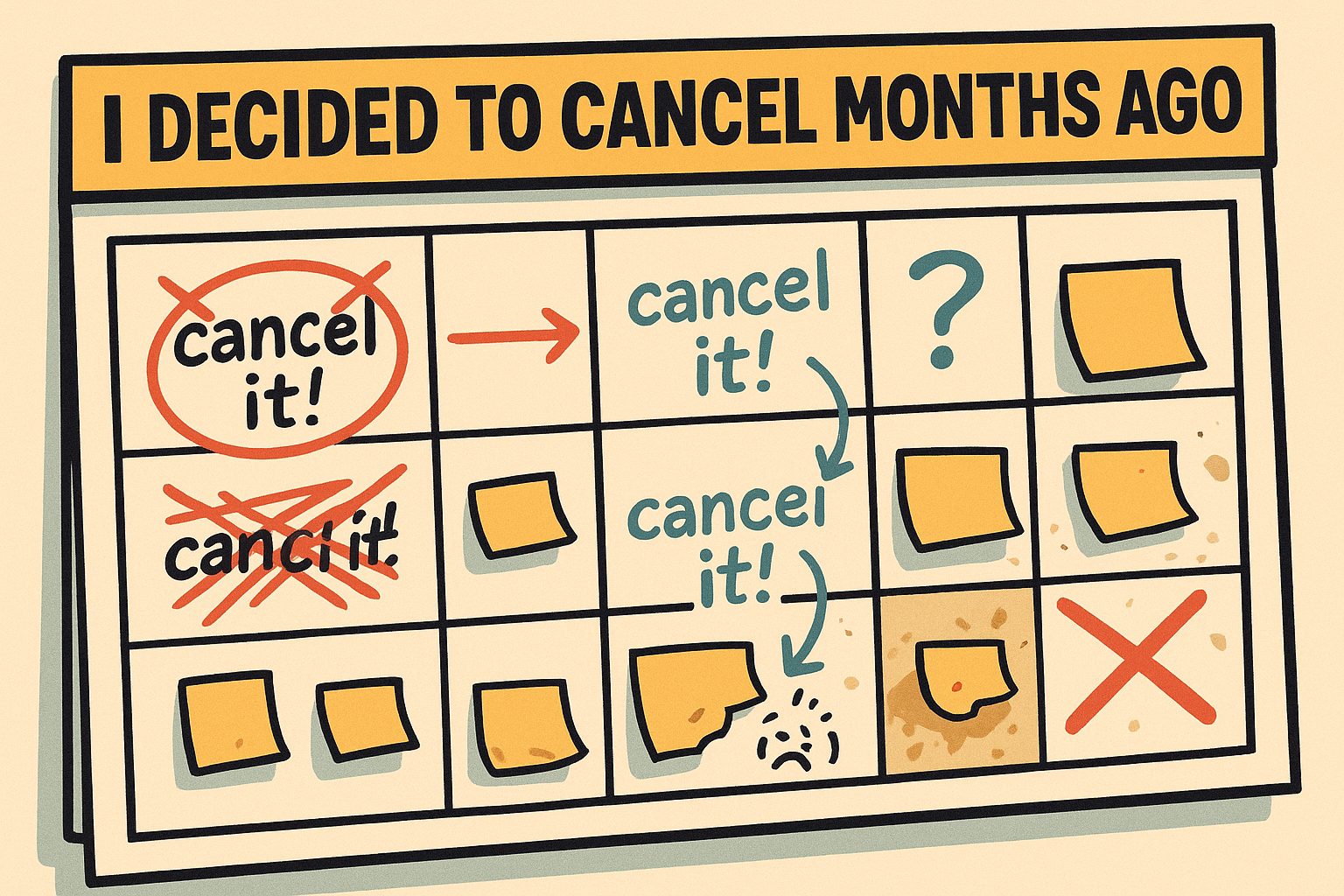
Illustration only.
The sentence that does the damage
“I’ll cancel it after this billing cycle” sounds frugal. The month is already paid for, so why not use it? But the sentence has no date in it. It moves the cancellation from now to later, and later is exactly where an automatically renewing charge never gets caught. The cycle rolls over before the intention resurfaces, and the same reasoning applies again, because you are, once again, paid up.
The useful question is not “why am I so undisciplined” but “what specifically about this task makes it slip”. Three mechanisms with published evidence cover most of it.
Three reasons the decided cancellation survives
Sources checked September 24, 2026. These are published studies, not tests run for this article. None of them measured subscription cancellation directly except the second; the mapping to “I’ll cancel it next month” is editorial.
| Mechanism | Evidence | What it says | How it shows up here | Limits |
|---|---|---|---|---|
| Status quo bias | Samuelson & Zeckhauser, “Status Quo Bias in Decision Making”, Journal of Risk and Uncertainty 1 (1988) 7–59 | In questionnaire experiments, labelling one option as the current state made people pick it far more often than the same option under neutral framing; the bias grew as the number of alternatives grew. Field data on Harvard health plans showed only about 3% of employees switched plans in a year, and continuing enrollees’ choices differed from those of new enrollees facing the same menu | Keeping the subscription is the status quo. Cancelling is the alternative that needs an action, so it loses by default | Experiments used hypothetical decisions; the field data is 1980s employee benefits, not consumer subscriptions |
| Billing inattention | Einav, Klopack & Mahoney, “Selling Subscriptions” (NBER w31547) | Using payment-card network data on ten popular US subscriptions, the authors find that months in which a card is replaced, which forces an active decision, show much higher cancellation rates than ordinary months. They estimate inattention raises seller revenue by between 14% and more than 200%, depending on the service | The renewal is invisible unless something forces you to look at it. A “cancel next month” intention has nothing forcing the look | Ten services only; the paper does not say which mechanism inside “inattention” dominates |
| Pennies-a-day framing | Gourville, “Pennies-a-Day”, Journal of Consumer Research 24 (1998) | A cost framed as a small ongoing amount gets compared with other small expenses rather than with the aggregate it adds up to | The monthly figure looks too small to justify a login, a settings hunt and a retention screen | Laboratory framing studies with hypothetical transactions |
The third row is why the effort feels disproportionate. A single charge is compared with a coffee, and losing a coffee’s worth is not worth ten minutes of menus. The same charge over three years is a different comparison, which is the arithmetic in the post on why small subscriptions are hardest to cancel.
Underneath all three is a quieter pull that the status quo paper discusses under loss aversion: once you hold something, giving it up is weighed as a loss, even when you would not pay to acquire it today. Cancelling feels final in a way that “maybe next month” does not, so the decision stays suspended in a third, invisible column: cancelled in principle, open in practice.
Illustration only.
What “next month” is missing: a trigger
The distinction that matters is between a goal and a plan for the goal. In the goal-pursuit literature the plan is called an implementation intention, an if-then statement fixed in advance: if situation Y occurs, then I will do X. Gollwitzer & Sheeran’s 2006 meta-analysis (Advances in Experimental Social Psychology 38, 69–119) pooled 94 independent tests and found a medium-to-large effect on goal attainment (d = 0.65) compared with holding the goal alone. The authors note the plans work partly by making the cue for action easy to detect and the response automatic.
“Cancel the video-editing app sometime” is a goal. “On Saturday at 9 a.m., when I open the laptop, I go to Account, Billing, Cancel” is an implementation intention. The second version has a cue that will actually arrive.
A caution on what this post does not rely on. The most-cited study about self-imposed deadlines and procrastination, Ariely & Wertenbroch (2002), was retracted by Psychological Science on September 2, 2026 after a failed replication and a data-forensics analysis. Deadlines may still help; that particular evidence no longer counts.
The worksheet: give the third column a date
This is an editorial procedure, not something measured on real accounts. It takes about as long as reading a bank statement.
- Open your last statement and list every recurring charge. If that list is longer than you expect, the statement-search method covers where charges hide.
- Sort each line into three columns, not two: keep, cancel, and cancelled in principle. The third column is anything you have already told yourself you should cancel. Be honest; that is the column this post is about.
- For every line in the third column, fill in the row below.
| Service | Monthly charge | Next renewal date | How you signed up (web, app store, phone) | If-then plan | Done |
|---|---|---|---|---|---|
| example: video editor | $12 | October 3 | web | Saturday 9 a.m., laptop open → Account → Billing → Cancel |
Two details in the table carry the weight. The renewal date turns a vague window into a deadline, and the sign-up channel tells you where the cancel button will be, because most services make you leave the way you came in; the post on which subscriptions let you quit online shows which still require a call.
A worked hypothetical: say the third column holds four services at $6, $9, $12 and $15 a month. That is $42 a month, $504 a year, for things you have already decided against. Deferring the four cancellations by “one more cycle” three times costs $126. The numbers are illustrative, not a survey result; put your own in.
Illustration only.
Cancelling is usually reversible, but check what is kept
Part of the suspended decision is the thought “what if I need it next month?” For most monthly plans the honest answer is “then resubscribe next month”, at the same price, which is cheaper than paying for the months in between. How reversible that really is depends on what the vendor keeps after you leave: some retain your files and history for months, some delete them on a schedule, and the data-retention comparison lists what several well-known services actually promise. If your data matters, export it before the cancel click rather than trusting the resubscribe button to restore it.
One more thing to check before choosing “pause” instead: many services do not offer a real pause at all, and some pauses quietly resume billing, which is the subject of the pause-button post.
Illustration only.
Annual plans are a different species
The method above assumes a monthly cycle, where a missed cancellation costs one more month. An annual plan often does not prorate, so cancelling mid-term can mean losing access you have already paid for, and the renewal date is far enough away that “I’ll deal with it before it renews” has eleven months of runway to be forgotten. The break-even arithmetic and the calendar rule for that case are in the post on the annual plan you regret before the first renewal. For annual plans, the if-then plan should be dated at least two weeks before the renewal, not on the day.
The law is moving toward one click, but it is not there yet
Some of the friction is deliberate, and regulators in several places have been trying to remove it. The status matters for the worksheet because it tells you whether to expect a reminder email and an online cancel button, or to plan for a phone call.
Status checked September 24, 2026.
| Jurisdiction | Rule | Status | Source |
|---|---|---|---|
| United States (federal) | FTC “click-to-cancel” amendments to the Negative Option Rule (2024) | Vacated by the Eighth Circuit in July 2025 on procedural grounds. The FTC restarted the process with an Advance Notice of Proposed Rulemaking published March 13, 2026 (comments closed April 13, 2026); no new rule is in force. ROSCA and Section 5 of the FTC Act still apply | Covington summary; FTC Negative Option Rule page |
| California | AB 2863, amending Business & Professions Code §17602 | In force for contracts entered, amended or extended on or after July 1, 2025. Cancellation must be available “in the same medium that the consumer used” to sign up (§17602(f)); an annual reminder must state the service, the charge frequency and amount, and how to cancel (§17602(h)) | Bill text |
| United Kingdom | Subscription contracts regime under the Digital Markets, Competition and Consumers Act 2024 | Not yet commenced. The government’s April 2026 consultation response moved the expected start to spring 2027; planned obligations include pre-renewal reminder notices, a 14-day renewal cooling-off right after free trials, and exit “via the same channel” as entry | Reed Smith summary |
Two practical readings. If you are in California and signed up online after July 2025, you are entitled to an online cancel path and a yearly reminder, so a service that insists on a phone call is worth reporting rather than obeying. Everywhere else, assume the reminder will not come and put the date in your own calendar. The cancellation-and-refund comparison shows how differently individual vendors handle the exit even now.
When the deferral is a signal
There is a failure mode in the opposite direction. Sometimes a service sits in the third column because part of you is not ready to lose it, and the vague “next month” is doing real work by keeping the option open. My view is that the test is simple: if closing the account produces relief, it was a leak; if it produces regret, it was not a subscription to cancel but one to start using, or to admit you wanted. Cost per use is the honest way to tell which one it is before the click, not after.
The short version
- Keep three columns, not two. The third one, decided but still billing, is where the money goes.
- Every line in that column gets a renewal date, a sign-up channel and an if-then plan with a time and a place.
- Export anything you need before cancelling; check the retention policy rather than assuming resubscribing restores it.
- Treat annual plans separately and date the plan two weeks before renewal.
- Do not wait for a legal reminder outside California; the UK regime starts in 2027 at the earliest and the US federal rule is back at the drawing board.
None of this is advice about what you should subscribe to. It is a description of why a decision and an action come apart, with the published evidence for each part, and a procedure that gives the action the one thing the decision lacked: a moment when it was supposed to happen.
Sources: Samuelson & Zeckhauser 1988, Einav, Klopack & Mahoney, NBER w31547, Gourville 1998, Gollwitzer & Sheeran 2006, Retraction Watch on Ariely & Wertenbroch 2002, Covington on the FTC ANPRM, FTC Negative Option Rule, California AB 2863 text, Reed Smith on the DMCC subscription regime.
Related reading
Most Subscriptions Have No Turn Off Auto-Renew Button
How to turn off auto-renew on nine subscriptions: most make you cancel, Microsoft has a real off switch, and Adobe charges 50% to leave.
Streaming Prices: Compare Ads, 4K and the Plan You Need
Compare US streaming prices, ad-free upgrades, 4K and screen limits with official sources, verification gaps, and a worksheet for your annual viewing budget.
Which Gift Cards Actually Stop a Subscription From Auto-Renewing
Compare gift-card renewal rules for seven services, including saved-card billing, prepaid-plan exceptions, and what to check before redeeming credit.
Which Subscriptions Let You Quit Online — and Which Still Make You Call
Gyms and cable still force a phone call, a letter, or an in-person visit to cancel; Audible and Amazon take two clicks. Eight subscriptions compared on leaving.