What a VPN Costs per Device, and Which Providers Publish Proof of No Logs
Seven VPN providers compared on real prices, device limits, logging policies, jurisdiction, and refund windows, checked against each vendor's own pages.
Every VPN landing page prints roughly the same three phrases — “no logs,” “bank-grade encryption,” “protect your privacy.” Those words are free to print, so none of them help you choose. The differences that actually matter sit in less friendly places: what the plan renews at when the teaser ends, how many devices one account really covers, whether an outside auditor has verified the no-logs claim, and which country’s courts can compel the company to hand over data. This comparison covers seven providers on exactly those points.
We collected every cell below from each provider’s own pricing, features, or policy page on 2026-09-25. Where a page was geo-localized, rendered client-side, or bot-blocked so a number could not be read directly, we left the cell blank rather than fill it from memory or a review site. A table with a hole in it is more honest than a complete-looking one built on guesses, because a VPN’s entire value is that you cannot verify what the provider does on your behalf — so the reliability of the comparison has to stand in for it.
| Provider | Cheapest plan (as listed) | Renewal / list price | Devices | Logging policy (verified) | Jurisdiction | Money-back |
|---|---|---|---|---|---|---|
| Mullvad | €5/month (flat, any term) | €5/month — no teaser | 5 | No activity logs at all: no traffic, DNS, or connection logs | Sweden (14 Eyes) | 14 days |
| IVPN | $6/month, or $60/year (Standard) | $60/year — flat | 5 (10 on Pro) | States no activity logs; open-source clients | Gibraltar | 30 days |
| Proton VPN | Free tier ($0); paid price not captured | Not verified | 10 | No logs, open-source, independently audited | Switzerland | 30 days |
| ExpressVPN | $2.99/month intro (28-month plan, $83.72 total) | $99.95/year after first cycle | 10 (12 Advanced, 14 Pro) | No logs; 19 audits (KPMG, PwC, Cure53); RAM-only servers | British Virgin Islands | 30 days |
| Private Internet Access | $2.03/month (multi-year, $79 every 3 years) | $79 / 3 years | Unlimited | Strict no-logs, reviewed in multiple audits | United States (5 Eyes) | 30 days |
| Surfshark | Intro-priced 24-month plans (USD not captured — localized) | Not verified | Unlimited | Audited no-logs policy | Netherlands (9 Eyes) | 30 days |
| Windscribe | $5.75/month ($69/year) | $69/year — flat | Unlimited | No identifying logs | Canada (5 Eyes) | 7 days, under 10 GB used |
Verification date: 2026-09-25. Prices and policies change, and VPN prices in particular are geo-localized and promotional — re-check before an annual plan renews.
Sources: Mullvad pricing · Mullvad no-logging policy · IVPN pricing · Proton VPN pricing · ExpressVPN plans · ExpressVPN privacy policy · Private Internet Access · PIA about · Surfshark pricing · Windscribe plans · Windscribe features · Windscribe refund policy
The teaser rate is not the price
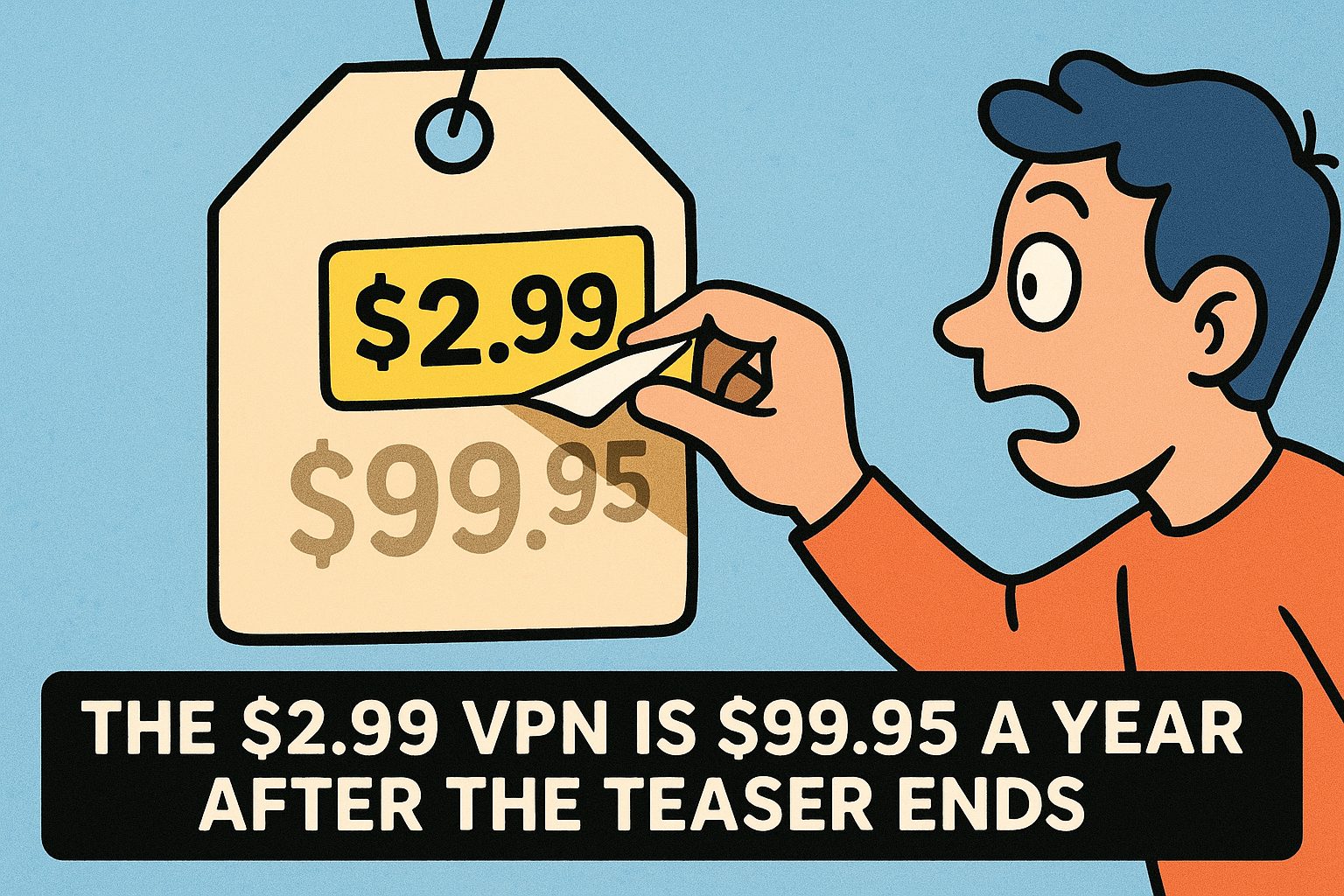
The single most important number on a VPN pricing page is the one in the smallest font: the renewal. ExpressVPN advertises $2.99 a month, but that figure is a 28-month intro bundle paid up front at $83.72, after which the subscription auto-renews at $99.95 a year — about $8.33 a month, close to triple the headline. Private Internet Access advertises $2.03 a month, but only if you commit to a multi-year term billed $79 at once. Against those, Mullvad (a flat €5), IVPN ($60 a year), and Windscribe ($69 a year) sell one price with no first-cycle discount at all. The teaser providers are pricing the signup, not the product, and betting you will forget before the renewal. The flat providers have no such second number to reveal.
Cost per device, not per month
A VPN is usually a whole-household decision, which makes the device limit the real multiplier on its price. Private Internet Access, Surfshark, and Windscribe allow unlimited simultaneous connections. Mullvad and IVPN cap at five (IVPN sells a ten-device tier), and ExpressVPN scales from ten to fourteen by tier. For a home with three phones, two laptops, and a router, a five-device cap means choosing which devices go dark — or paying for a higher tier to avoid the choice. The unlimited plans are the cheapest per device for a large household, which is the opposite ordering from their per-month prices.

“No logs” is a claim; an audit is evidence
Every provider in this table prints “no logs.” What separates them is whether anyone outside the company has verified it. ExpressVPN publishes 19 third-party audits from KPMG, PwC, and Cure53, and runs its servers on volatile RAM so data cannot outlive a reboot. Proton VPN is open-source and independently audited. Surfshark and PIA both point to public audits, and Mullvad’s policy page states outright that it keeps no traffic, DNS, or connection logs. A no-logs claim that no auditor has checked is not worthless — but it is uncheckable, and with a service you hand all your traffic to, “trust us” and “here are the receipts” are different products. That distinction is the same one behind the question of which apps encrypt by default rather than by option, because a default that can be turned off is not a guarantee.
Jurisdiction decides whether the promise is enforceable
A no-logs policy only matters as long as the company is not required to start keeping logs. A provider based where data-retention obligations or surveillance-sharing apply — the Five, Nine, and Fourteen Eyes alliances — can be legally compelled to record and hand over data that a no-logs policy would otherwise never produce. ExpressVPN (British Virgin Islands), IVPN (Gibraltar), Proton (Switzerland), and Surfshark (Netherlands) are based in jurisdictions chosen to keep foreign orders at arm’s length. PIA (United States), Windscribe (Canada), and Mullvad (Sweden) sit inside Five and Fourteen Eyes countries. This is why the jurisdiction and logging rows have to be read together, not separately: a strong no-logs policy inside a surveillance-sharing country is a weaker promise, on paper, than the same policy offshore.

A VPN routes all of your traffic through a machine the provider controls, so trusting one is closer to the question of who actually holds the keys to your email inbox than it is to a normal software purchase. The provider is technically in a position to see everything you send; you are taking its word — or better, its auditor’s word and its jurisdiction’s word — that it does not. The strongest configurations pair an audited no-logs policy with an offshore home; the weakest pair an unaudited claim with a Five Eyes address. Most real choices sit in between, and none of them is a single “best.”
The refund window is the only safe trial
Because a VPN’s value is trust rather than a feature you can see, the refund window is the one way to test the promise before committing. Six of these seven providers run a 30-day guarantee (ExpressVPN, PIA, Surfshark, Proton, IVPN) or a 14-day window (Mullvad). Windscribe is the outlier: its refund must be requested within seven days, only if you have used under 10 GB, and renewals are excluded outright. If your first instinct after signing up is to stream a few hours of video before deciding, you will have blown past Windscribe’s cap before you finish evaluating it — a real constraint worth reading before you pay.
Bundling hides the VPN price
ExpressVPN now folds an email-relay service, a password manager, and an eSIM into its higher tiers, so the headline VPN price is increasingly a bundle price — the same mechanism as a storage plan that ships productivity apps you will never open. When the VPN arrives bundled with services you already own, you are paying for the VPN plus the unused remainder, and the bundle is what makes the $2.99 teaser look like the whole story. This is the recurring-charge problem in miniature, and it is why the renewal figure, not the teaser, is the number to write down.
What a VPN does not do
A VPN encrypts the leg between your device and the provider and hides your IP address from the sites you visit. It does not protect you from a phishing page you type credentials into, it does not anonymize you against an adversary with a warrant and a cooperating jurisdiction, and it does not stop the sites you log into from recognizing you by your account. Those boundaries are the difference between a tool and a false sense of security, and they are covered in more detail in the piece on what a VPN does and does not protect.
A working order of operations
A dependable way to compare these services without falling for the marketing is to read the rows in this order: the renewal price instead of the teaser, the device count you will actually use, whether the no-logs claim is audited rather than asserted, the jurisdiction next to the logging policy rather than apart from it, and the refund window before anything is charged. Run through once, that sequence surfaces the differences this table is built to expose — and explains how two services with the same three marketing words can be different products. If you need a straightforward tunnel and want to avoid surprises at renewal, the flat-priced providers are the easiest to reason about; if you want the strongest audited-plus-offshore combination, the trade-off is usually a higher effective price or a tighter device cap. Either way, the answer lives in the fine print, and the fine print is dated above.
Related reading
Who Holds the Keys to Your Email Inbox
Most email is encrypted in transit, but only some providers cannot read your inbox. Seven services compared on price, storage and who holds the keys.
Encrypted Note Apps Compared: Who Can Read Your Notes, and What Each Plan Costs
Which note apps are end-to-end encrypted, what each paid plan costs, and how you get your notes back out — five apps checked against their own pages.
Password Managers Compared — Free Limits, Annual Price, and Who Can Read Your Vault
Seven password managers compared on free limits, annual price, zero-knowledge encryption, and export, checked against each vendor's own pages.
Cloud Backup Is Not Sync: What a Real Backup Costs and Who Holds the Keys
Six backup services compared on price, encryption, version history and restore — and why a synced folder is not a backup.